
Advanced Athletics™
Advanced Athletics™ is one of the top Sport/Fitness influencer in United States with 14662 audience and 0.06% engagement rate on Instagram. Check out the full profile and start to collaborate.

14.7k
Audience
9
Engagement
 United States
 Verified account
  Fast reach-out capability
 Niche categories
Sport/Fitness
Portfolio
Standout projects making waves around the web
Here’s the truth: your body doesn’t just age, it loses mobility, strength, and coordination if you ignore it. . Every skipped workout, every stiff joint, every avoided challenge is time stolen from moments that matter most. . Being athletically fit isn’t vanity, it’s presence. . It’s being the parent or grandparent who joins the game, keeps up, and makes memories instead of watching life pass by.
Landmine variations force your body to move in arcs, diagonals, and rotations. They teach your spine to resist unwanted rotation, your shoulder girdle to stabilize under uneven load, and your core to link force from the legs through the torso safely. A single-arm landmine press isn’t just a press, it’s a stability and rotational control exercise. A landmine row isn’t just a row, it’s a spinal decompression and anti-rotation drill at the same time. Your nervous system learns that force can travel in multiple planes without breaking the body. Here’s the medical why: monotony in training leads to asymmetrical stress. Repetitive linear loading over decades accelerates micro-trauma in discs, rotator cuffs, and joint capsules. Tendons and ligaments stiffen in protective patterns. Fascia becomes imbalanced. That’s why two decades of “strength” can leave you fragile in motion. Introducing diversity through landmine lifts trains muscles, joints, and connective tissues to handle force in unexpected directions, restoring coordination, resilience, and long-term joint health. Diversity matters because longevity is about movement versatility, not just maximal strength. You want hips, shoulders, spine, and knees that can absorb, redirect, and generate force safely in any plane. Landmine barbell variations do that. They retrain your nervous system to anticipate load, teach your joints to move dynamically, and protect your body from the slow creep of compensatory injuries that aging athletes feel all too soon. If you stick to the same straight-line lifts, your body will eventually make you pay. Landmine work teaches it to survive and thrive under stress in every direction. That’s not just strength. That’s longevity. That’s athleticism you can carry into your 40s, 50s, and beyond without pain stealing the show. Yours, Adam.
Most athletes think power comes from the arms or legs. But here’s the truth, if your core isn’t firing correctly, every twist, throw, or pivot is leaving your spine and hips to pick up the slack. That’s where the Tall Kneeling Medicine Ball Rotational Toss comes in. If you’ve ever felt a twinge in your low back when twisting, noticed your shoulders lagging behind your hips, or felt awkward when trying to generate force explosively, that’s the exact problem this drill fixes. When you kneel tall and toss the ball, your pelvis is locked, your lower body removed from the equation, and your torso and core must generate and control all rotational force. Medically speaking, your spine and obliques are forced to coordinate in a controlled sequence, rotating without letting the lumbar spine hyperextend or shear. This isn’t just about throwing a ball. It’s about teaching your nervous system to link the deep core, obliques, and shoulder stabilizers under explosive rotational load. It retrains the spine to resist unwanted motion while your torso moves, protects discs from torsional stress, and teaches your hips that they don’t need to compensate for weak trunk control. That’s why your rotational power increases without your back paying the price. The eccentric control on the follow-through teaches your muscles to decelerate force safely. The transverse plane challenge restores coordination between left and right sides, balancing asymmetries that develop over years of one-dimensional training. Ignoring this means your lower back will keep reminding you that your core isn’t ready for rotation, and that’s how chronic pain and small joint injuries sneak up on athletes over 40. Do this drill consistently, and your torso becomes a force transmitter, not a weak link. Your throws, swings, and pivots feel smooth, powerful, and safe. That’s not flashy, it’s longevity. That’s how you stay athletic, explosive, and injury-resistant for decades. Yours, Adam.
????????Shoulder warm-up and posture reset. . . #shoulderworkout #shouldermobility #mobilitytraining #prevention #athletics #fitnessaddict #challenge #athleticresilience #durableathlete #trainingconfidence #strengthtraining #injuryfreeprevention #athleteforlifeapp #athleticlongevityprocess #advancedathletics #motivation #fitnessmotivation #trainingmotivation #trainhard #recoverymethod #beatheltic #stayatheltic
Listen, if your core feels like it’s working, but your movements are still sloppy, jerky, or you catch yourself twisting your spine the wrong way when you reach or sprint, the problem isn’t strength. It’s control. And that’s exactly what the Rapid Response Base Rotations are fixing. Your spine isn’t designed to twist wildly while your pelvis and hips lag behind. When the nervous system doesn’t know how to stabilize your torso during rotation, the lumbar spine ends up doing all the work. That’s why your lower back twinges when you pivot, why your knees wobble when you change direction, and why sudden rotational movements feel dangerous even though your muscles are “strong.” This drill attacks that exact problem. It retrains your core, obliques, deep spinal stabilizers, and hips to communicate reflexively. The moment your body feels an unexpected rotational force, the muscles fire in a coordinated sequence, protecting your joints and transferring power efficiently from the feet through the pelvis into the torso. That’s the difference between feeling strong in a gym machine and being resilient on the field, on the track, or even walking upstairs carrying something heavy. The medical why is simple but brutal: if you don’t train rotational stability, your spine becomes the weak link in every twist, turn, and load. Ligaments take stress they aren’t built for. Discs and vertebrae get compressed asymmetrically. Your hip rotation gets cut short. Your neural pathways forget how to link your core and lower body under pressure. That’s why chronic tension, micro-injuries, and awkward movement patterns appear out of nowhere. When you train it right, your brain learns that rotation is safe, strong, and coordinated. Your hips pivot without dragging the spine. Force moves cleanly through your legs, your pelvis, and into your torso. Rapid twists stop being a liability, they become an asset. This isn’t flashy. It’s not about looking cool. It’s about rewiring your body to survive movement that would otherwise break it. And trust me, if you skip this layer, your spine, your hips, and your knees will make sure you regret it over time. Yours, Adam.
2026-02-28
 13
13
13
Most athletes think power and plyometrics are all about the legs. Squat jumps, box jumps, sprinting drills, they dominate the program. Sure, your lower body generates force, but if your upper body never learns to produce, transfer, and absorb power, the rest of your body pays the price. That’s why chest slaps, medicine ball tosses, rotational punches, overhead slams, power dips, KB snatches and cleans, and TRX grappler throws matter, they solve a problem aging athletes ignore. Here’s the problem: as you get older, your nervous system becomes less efficient at linking the core and upper body to lower body power. When the hips generate force, if the chest, shoulders, and arms aren’t trained to receive it, force leaks through your spine, shoulders, and elbows. That’s why many experienced lifters tweak their shoulders or feel spinal tension, they produce power but fail to transfer it safely. Upper-body plyometrics retrain fast-twitch recruitment, rate of force development, and joint stability simultaneously. Medicine ball rotational punches and chest passes teach the core and shoulders to handle explosive load, maintain alignment, and link rotational force from the hips through the torso. Overhead slams and plank pop-ups train eccentric control under speed, teaching muscles to decelerate force instead of letting joints absorb it. The medical why is critical. If your upper body isn’t prepared, the spine and shoulder girdle become the weak link. Discs, rotator cuffs, and connective tissue absorb forces they weren’t designed for, accelerating wear and tear. Integrate upper-body plyometrics to restore proper force transmission, reduce compensatory stress, and improve athletic resilience. Lower-body power matters, but if your upper body can’t follow, you’re leaving performance and longevity on the table. Train chest, shoulders, and torso to move explosively and safely, and every pivot, lift, and sprint becomes smoother, faster, and safer. Power isn’t just what your legs do, it’s how your whole body communicates under load. Yours, Adam.
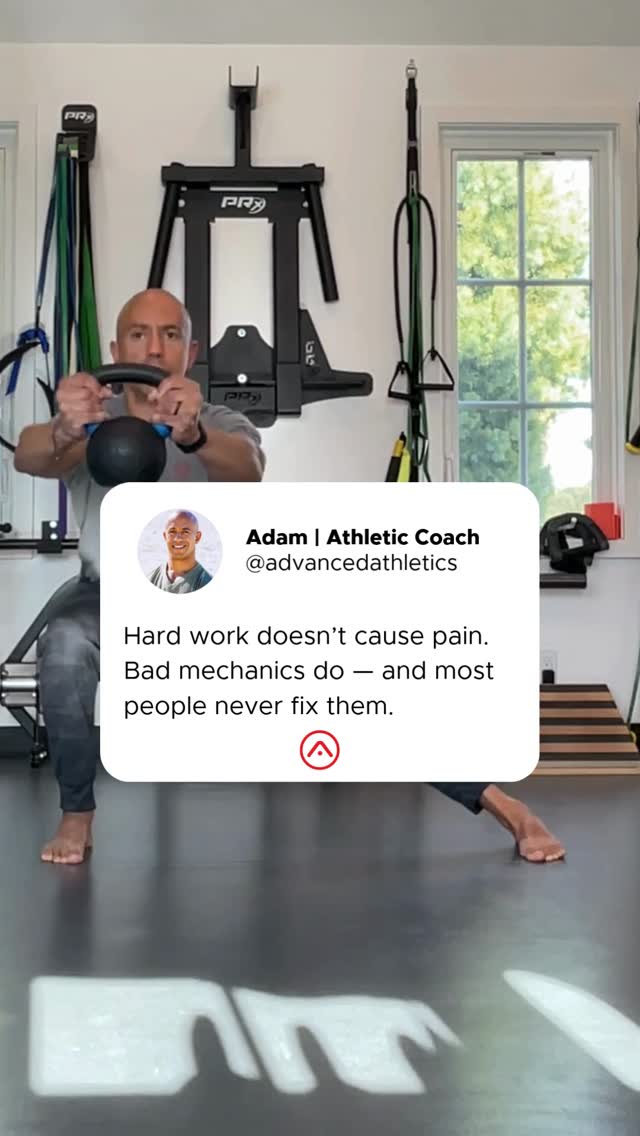
Most athletes train strength in straight lines: squats, presses, deadlifts. But the real breakdown happens when force moves sideways or rotationally, when your hips lag, your spine overcompensates, and your knees wobble under load. That’s how chronic low back pain starts, how hip mobility gets cut short, and how every sprint, pivot, or lift suddenly feels risky. If you’re over 40, you probably feel it, the small twinges in your knees, stiffness in your hips, the lower back that tightens when you twist or change direction. That’s not just “getting older.” That’s the cost of decades of your nervous system forgetting how to link your feet, hips, and torso under unpredictable loads. That’s exactly why these drills matter: Rapid Response Side-to-Side Hip Twist, Rapid Response Base Rotations, and the Two-Foot Lateral Base Drill. They retrain reflexive stability, forcing your body to fire in real time so force moves efficiently without your spine taking the hit. The Side-to-Side Hip Twist teaches lateral control and hip dissociation. Base Rotations train your torso to resist unwanted rotation while letting the hip move freely. The Two-Foot Lateral Base Drill reinforces balance, joint centration, and reactive control under side-to-side loading. The medical why is brutal but simple: when your brain forgets how to sequence stabilizers, ligaments and discs take the stress your muscles should absorb. Protective tension builds, joints stiffen, and strength alone no longer protects you. Do these drills consistently, and your hips move independently of your spine. Your knees stop wobbling. Your core reacts instantly. Every pivot, sprint, or step becomes safer, more powerful, and resilient. That’s not just performance—it’s athletic longevity. Neglect lateral and rotational control, and your body will make you pay. Respect these planes of movement, they’re where aging athletes lose control first, and where longevity is won. Yours, Adam.
2026-02-28
10
10
If your hip feels tight every time you bend, run, or even sit for long periods, it’s not just “tightness.” . It’s weakness at end range. Your hip flexors aren’t just short, they aren’t strong where they need to be. . That’s why your stride feels off, why your lower back starts taking over, and why even lifts that should feel easy suddenly feel jerky or unstable. . Most people never train their hip flexors through a full range of motion. They stretch. They foam roll. . They hope it helps. But the real problem lives at the lengthened end of the hip flexor, the position where the muscle is long and the joint is vulnerable. . That’s where tight hips originate and where compensations start. That’s also where injuries creep in over time. . When you teach your hip flexors to produce force while long, you’re doing more than strength work. . You’re retraining the nervous system to trust that end range. You’re telling your spine it doesn’t have to pick up the slack. . You’re restoring proper hip mechanics for walking, running, and lifting. That’s why you feel safer, more stable, and actually stronger in motion, not just on paper. . Control matters more than speed here. If your body is newer to this, slow down. Emphasize the lowering phase. Build strength where stretching alone can’t fix it. . Keep your core locked, your ribs down, and force moving through the hips, not the back. This isn’t flashy. It’s resilience. It’s longevity. It’s what keeps your hips doing their job while protecting your spine and knees. . If you ignore this, your lower back will always complain first, and your hips will never fire the way they should. . But train it right, and every step, squat, and sprint becomes smoother, safer, and far more powerful. . Yours, Adam.
2026-02-28
12
12
Why do strong athletes still break down? . Because longevity isn’t lost in the lifts you train. It’s lost in the movements you avoid. . I’ve spent decades studying how athletic bodies age under load. What fails first isn’t strength. It’s control during rotation, lateral shift, and deceleration. . Medically, this is where the nervous system hesitates first. Proprioceptive feedback slows. The glute med and deep hip rotators fire late. The foot fails to anchor. Force leaks upward into the knee, hip, and lumbar spine. . That’s how non-contact injuries happen. Not from weakness. From delayed stabilization when force arrives from the side or through rotation. . You don’t lose athleticism overnight. You lose it when your body can’t manage angles it never practiced. . Longevity is earned in the movements you avoid. . So ask yourself When was the last time you trained sideways, rotational, or decelerative control with intent? . Yours, Adam.
